

The TL;DR (Executive Summary)
LinkedIn gives salespeople, consultants, founders, and business professionals tools that can help them connect, listen, learn, engage, and build trust.
The problem is not the tools. The problem is how some people use them.
When people use connection requests, messages, comments, AI, and Sales Navigator as shortcuts to pitch faster, they train others to become more guarded.
Bad outreach does not just hurt the person sending it. It makes the platform feel worse for everyone else trying to use it the right way.
The better path is not complicated: earn attention before asking for time, bring relevance before making the ask, and treat LinkedIn like a relationship platform instead of a digital vending machine.
There are moments on LinkedIn when all you can do is shake your head and mutter the only reasonable response:
This is why we can’t have nice things.
Dramatic? Yes. True? Also yes. But if you spend any real time on LinkedIn, especially if you teach, sell, consult, coach, lead, create content, or do business development, you know exactly what I’m talking about.
LinkedIn gives us an incredible set of tools to connect with people we never would have met otherwise. We can find the right people, learn about their work, and notice what they care about. LinkedIn then shows us who we know in common and exposes us to the content they want to share. We can then engage with their content, send thoughtful messages, and start conversations that will hopefully matter.
These are all nice things.
Then there are some people who take those same tools and use them to spray generic pitches, fake familiarity, automate pretend interest, and ask for time they have not come close to earning.
This is where the “can’t have it” part comes into play.
Frustration Delivered Straight to You
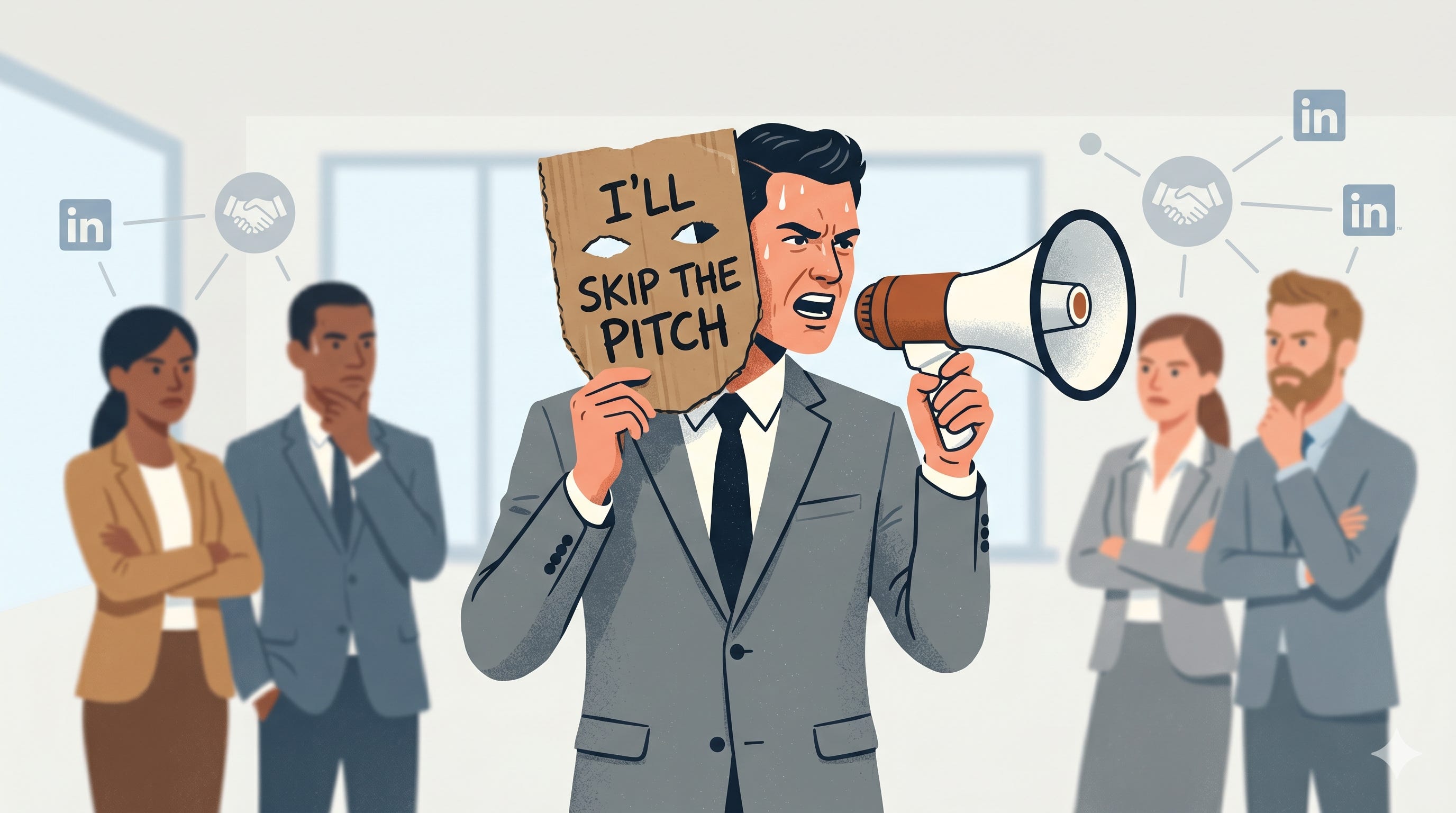
The moment that sparked this article came from a coaching call inside our Social Sales Link membership. Brynne Tillman shared an outreach message she received from someone who said he would “skip the pitch.” Then, of course, he immediately proceeded to pitch her.
Which is a… choice.
Not a good one, mind you. But definitely a choice.
And that’s the thing that makes this so frustrating. The person probably thought the message was clever. Maybe AI helped write it (or just wrote the whole thing). Or it at least structured it by leading with fake relevance, then enforcing it with generic references to the recipient’s expertise. Then create a little pattern interrupt and ultimately slide into the ask.
The problem is that people can feel that slide.
They can feel the pitch coming before you even get there, or the compliment is not really a compliment. Most importantly, they can feel when “no pitch” means “please lower your guard so I can pitch you more easily.”
That’s not trust-based selling… it’s a pitch in disguise.
The Tool Was Never the Strategy
One of the biggest mistakes people make on LinkedIn is confusing access with strategy. While LinkedIn gives you access to people, it does not give you permission to interrupt them poorly.
There is a big difference between being able to reach someone and having earned the right to reach out in a way that deserves their attention. Too many people treat LinkedIn like the first part is all that matters. They find a profile, send a connection request, drop a message, and assume the other person should be grateful for the opportunity to hear about their thing.
But nobody owes you that. (Here’s a recent article of mine that emphasizes that point all the more.)
They do not owe you their time, a reply, or the benefit of the doubt just because you believe your product, service, agency, program, platform, process, or “all-the-bells-and-whistles” solution can help them.
What LinkedIn does is give us the opportunity to become relevant before the ask… the part that too many people skip.
What are they skipping? Doing profile research, engaging with content, finding mutual connections, and more. Most importantly, they skip the part where the other person might begin to recognize them as useful.
Then they wonder why people do not respond.
Well…
Bad Outreach Trains People to Distrust Good Outreach
Here is the part that matters beyond one bad message. Every lazy pitch makes the next thoughtful message harder to trust. That’s where the real damage comes into play.
Spammy outreach not only fails for the person who sends it. It conditions the recipient to become more skeptical of everyone. And, trust me - that’s been going on around LinkedIn’s parts for years now.
When people misuse the tools, they do not just burn their own credibility. They make the room smokier for everybody. And this is especially true now that AI is making it easier to create messages that sound polished on the surface. A message can be grammatically clean, emotionally smooth, and structurally well-written while still being completely empty of actual relevance.
Don’t get me wrong: AI can help you think through a message and clarify your point. It can help you create content that’s less clunky than what you’ve written. It can even help you notice when your “ask” might come too soon.
But AI cannot care for you or decide that the person on the other end deserves respect. When your entire strategy is still “find target, send message, ask for call,” AI only helps to amplify it and make it easier to scale.
LinkedIn Gives Us Better Signals
The irony is that LinkedIn actually gives us so many ways to avoid this.
You can read someone’s About section, look at their content, and see what they're commenting on. You can notice what they are trying to teach, their frustrations, and what they seem to care about professionally.
LinkedIn provides us with many more signals, too, including:
Job changes
Company news
Their posts (before you ever send a message)
Sales Navigator, and all of its kick-ass tools to organize and prioritize people more thoughtfully
In other words, LinkedIn gives us clues. The problem is that clues only matter if you are willing to slow down long enough to use them.
Too many people treat LinkedIn like a shortcut when it is actually a context engine. It gives you context that can help you decide whether to reach out, how to reach out, when to reach out, and whether you have any reason to believe the outreach will be welcome.
That is a very different mindset from “I found your profile and thought we should connect.”
Did you, though? Or did I just happen to match the filters in your search?
“No Pitch” Is Not a Magic Spell
One of the stranger things happening in outreach right now is the rise of anti-pitch language that immediately turns into a pitch:
“I’ll skip the pitch.”
“Not here to sell you anything.”
“No agenda.”
“Just thought we should connect.”
“I promise this isn’t a sales message.”
Then, three sentences later… the pitch.
The problem is not that people use those phrases. The problem is that they use them as camouflage. Guess what? Using “this is not a pitch” doesn’t somehow change the fact that the message is obviously designed to get the other person into a sales conversation.
People are not stupid. They know when they are being moved through a funnel. They know when “collaboration” means “I would like to sell you something.” They know when “quick question” is not really a question. They know when “curious” is doing way too much work.
And once people feel manipulated, the trust is gone. That is the part sellers need to understand.
Trust is not created by labeling the message differently. It is created by behaving differently.
The Better Use of LinkedIn Is Slower, But Not Passive
Permission-based selling does not mean sitting around and hoping people magically find you.
There is nothing wrong with wanting sales conversations. There is nothing wrong with prospecting. There is nothing wrong with using LinkedIn for business development. I am a huge believer in all of it when it is done well.
But the conversation has to be earned. Not forced, tricked, or automated into existence.
Earned.
And the good news is that earning it does not require some wildly complicated system. It usually starts with a few basic questions before you send the message:
Have I shown any reason this person should pay attention to me?
Have I created relevance before making the ask?
Is this message about them, or is it just about my goal?
Would this feel respectful if I were on the receiving end?
Is there any human judgment in this, or am I just moving another name through a sequence?
Those questions will not slow down a good strategy. They will slow down a bad one.
And, yes… there is a difference.
The Nice Thing Is Still Worth Protecting
I still believe LinkedIn can be one of the best business relationship platforms we have. Not because it is perfect; believe me, it is not.
Not because everyone uses it well. They absolutely do not.
When it’s used with intention, LinkedIn allows people to build trust while they’re still at a distance (at first). It gives your expertise visibility and allows conversations to start before a meeting is ever booked. It lets people learn from each other, refer each other, introduce each other, and create opportunities that would not have happened otherwise.
Those are nice things.
The question is whether we are going to use it like adults. And that’s the part worth calling out.
The platform is not the strategy. The tool is not the relationship. The message is not the trust.
We are.
So before the next connection request, message, comment, follow-up, or “quick question,” it might be worth asking the uncomfortable but useful question: Am I using LinkedIn to earn trust? Or am I one of the reasons we can’t have nice things?
Keep asking those questions. Otherwise, you’ll run afoul of the statement I use to end all of my Substack articles:
Don’t be a salesy weirdo.
Earn those conversations.
