

The TL;DR (Executive Summary)
The first sales message may open the door, but the follow-up often tells the prospect what kind of salesperson you really are.
Most follow-ups fail because they add pressure instead of value. They remind the buyer of what the seller wants, instead of giving the buyer a reason to stay engaged.
“Just checking in” is usually not a strategy; it’s often seller-centered language wearing a polite little hat.
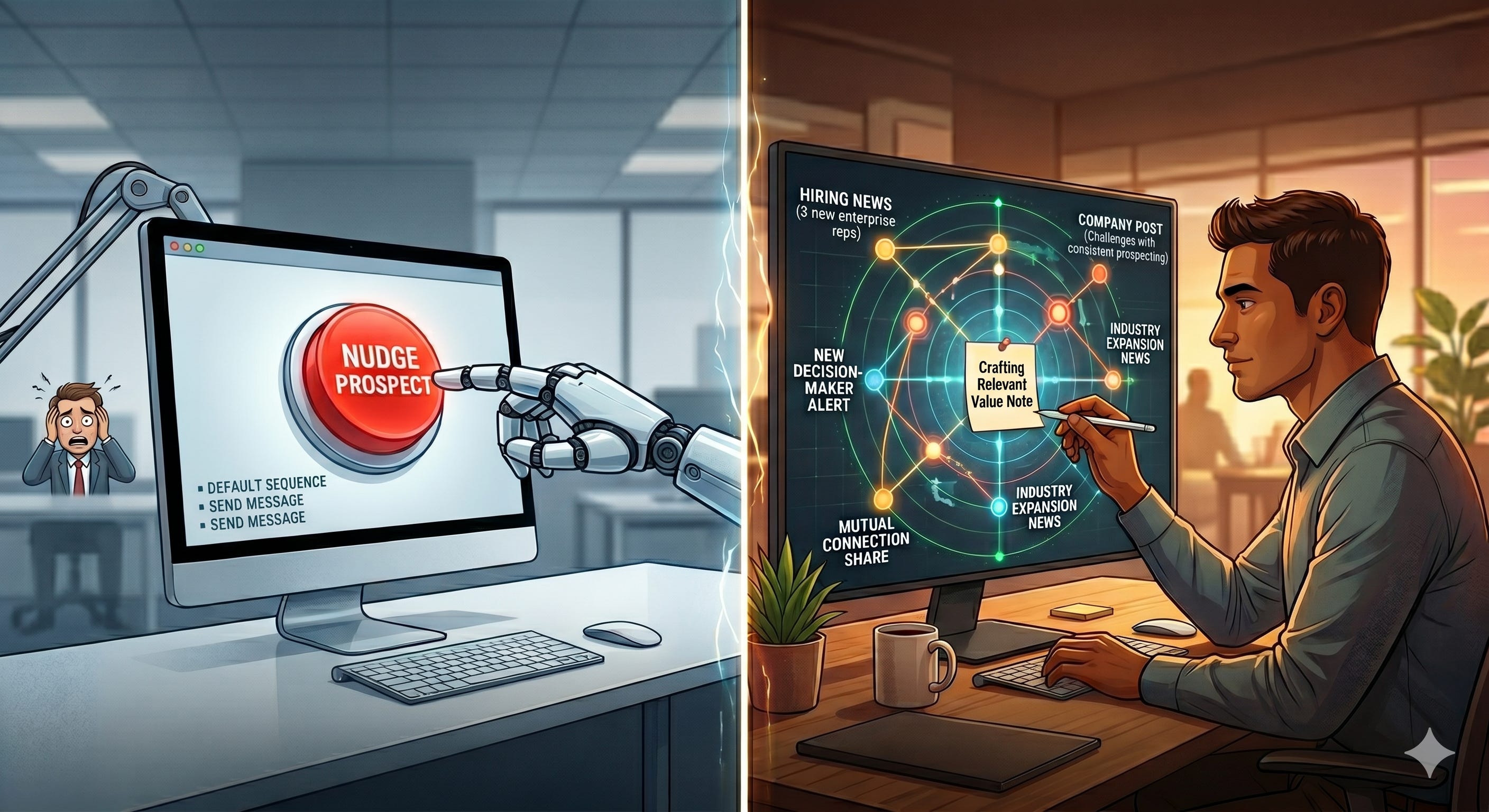
Better follow-up messaging continues the conversation with context, relevance, timing, and usefulness. It should feel like the next natural step, not another CRM box to click through your sales process.
LinkedIn, Sales Navigator, and AI can all help salespeople follow up better, but only when they are used to understand people more deeply… not to automate pestering them at scale.
Discover a “follow-up” test to determine if the subsequent messages you’re sending are continuing to earn you conversations with your prospects.
The First Message Gets All The Attention
A lot of advice exists out there about writing that “perfect” first sales message: the perfect opener, that killer subject line, the chef’s kiss LinkedIn connection request or cold email. A “pattern interrupt” that a psychologist would love, but usually ends up interrupting someone’s day in a way they didn’t ask for.
And yes, the first message matters. It is the introduction, after. It’s their first impression of you. Most importantly, it’s the first step to a potential conversation.
But I don’t think most salespeople lose the prospect with the first message. I think they lose them with the follow-up.
That’s where the truth comes out. The first message might be polished, researched, edited, and reviewed by a manager, a coworker, a sales trainer, a marketing person, and three different AI tools before it ever reaches the buyer.
The follow-up? It’s a totally different animal.
The follow-up often reveals what is really happening. It tells the prospect whether you are actually paying attention, or whether you are just working a sequence. It tells them whether your first message was the start of a thoughtful conversation, or just step one in a campaign.
That’s why I say the follow-up is where trust often goes to die.
The Follow-Up Reveals Intent
The first message can be dressed up… the follow-up usually can’t.
By your second or third touch, the prospect starts to get a much clearer picture of your intent. Are you trying to be helpful and understand their world? Are you trying to stay relevant? Or (speaking of CRMs) are you simply trying to move them from “unresponsive” to “meeting booked”?
That may sound harsh, but it is how many of these messages land.
The seller may think, “I’m being professionally persistent,” while the buyer thinks, “This person won’t leave me alone.” The seller may think, “I’m following the process,” while the buyer thinks, “I’ve been dropped into someone else’s process without my permission.” The end result here? The buyer likely ghosts the seller.
That gap matters because communication is not just about what you intended to send. It is about how the other person receives it. This is Communication 101, folks. But too many salespeople miss this piece. You can mean well and still create pressure. You can be polite and still be annoying. You can use soft language and still make the other person feel like they are being chased.
None of this is persistence. It’s pressure with better manners.
“Just Checking In” Is Not A Strategy
I learned this one many, many years ago… it was from a sales manager I was working with when I was in marketing for a start-up. Little did I know just how common it was (still is!) when I moved up to VP- and C-level positions.
“Just checking in.”
It feels harmless, polite. It feels like a gentle nudge instead of a hard push.
But from the buyer’s side, it often sounds like this: “I still need something from you.”
The problem here is what I learned from that wise sales manager many years ago: Zero value is delivered with “just checking in.” There’s no new context, and no new reason for the conversation. All of that and more adds up to no reason for the other person to care… other than the fact that you would like them to respond.
If you’ve done “just checking in,” I can guarantee you that you didn’t mean any of that when you used it. But that’s how it often lands with your prospect or lead. Again, Communication 101 comes in strong here.
And once a prospect feels like your follow-up exists only to serve your timeline, the trust starts slipping away. Not because you are a bad person, or you’re wrong to want a response. Not because follow-up itself as a concept is a bad one, either.
Trust slips away here specifically because the message is about you. They are just little pipeline pokes.
Bad Follow-Up Feels Like Pressure
Now we go from the inadvertently “bad” to the kind of thing most people know is “bad.” We’re talking:
“Bumping this to the top of your inbox.”
“Circling back.”
“Thoughts?”
“Any updates?”
“Did you have a chance to review?”
“Would it make sense to connect?”
None of these are crimes against humanity. Bad follow-ups do not always sound pushy. Sometimes they sound perfectly professional. And maybe just one message like this is actually the way to go in certain situations (I can’t speak to every single situation you face.)
But when these messages are stacked together over days or weeks, they begin to create a certain feeling. And that feeling is not usually trust… it’s obligation and pressure that can build up to annoyance.
It is the digital version of the much younger you putting your finger really close to your sibling’s face while saying in that annoying tone, “I’m not touching you!”
Here’s the problem, one that, as a seller, you may not have considered. You may view (and probably view) each follow-up as an individual message. The prospect, on the other hand, experiences them cumulatively. When you think about it, that distinction matters.
One message may seem harmless. Four of them, especially when none of them add anything useful, can make the prospect question whether responding will only make things worse.
That’s a place you don’t want to be. If the buyer starts thinking, “If I reply, this person is never going to stop,” you have not created momentum. You have created resistance.
Your Follow-Up Tells The Buyer What You Value
Every follow-up communicates something beyond the words themselves. If every follow-up asks for time, you value the meeting. If every follow-up asks for a decision, you value movement. If every follow-up asks for an update, you value your pipeline.
None of those things is automatically wrong. You’re in sales. You care about meetings, movement, updates, and pipeline. But the buyer does not owe you progress just because you reached out.
Your mindset has to shift from just reminders that you exist to demonstrating that the conversation is worth continuing. That means it should carry some kind of value: a relevant observation, a useful resource, a timely connection, a thoughtful question, or a new piece of context.
And not a massive research project. I’m talking about bite-sized chunks of content that are easy to digest yet important to fuel the buyer’s decision-making process. Something that makes the message feel like it belongs in their world, not just in your CRM.
A Better Follow-Up Continues The Conversation
A good follow-up should not feel like a disconnected nudge; instead, it should feel like the next natural step in a conversation with appropriate context.
That context might come from something the person said, something happening at their company, something changing in their industry, or something they posted, commented on, shared, or reacted to.
The keyword here is relevant, not personalized. There is a difference. Personalization is often surface-level. Relevance shows you understand why something may matter to the person receiving the message.
Personalized sounds like this:
“I saw you went to Ohio State.” (Go Bucks!)
… while relevant sounds like this:
“I noticed your team is hiring several new enterprise reps. When teams grow quickly, one challenge is making sure prospecting habits don’t become wildly inconsistent from rep to rep.”
One says, “I looked you up” (or my LinkedIn-illegal scraping tool looked you up), while the other says, “I thought about what might be happening in your world.”
Buyers can and do feel that difference.
The Best Follow-Up Doesn’t Need an “Ask”
This is where some sellers get uncomfortable because they’ve been trained to always drive to the next step: Book the meeting. Ask for the call. Get the demo. Create urgency. Move the opportunity forward. ABC (“always be closing”).
I get why that training exists. Salespeople need to create movement.
But sometimes the best follow-up is to ask for nothing. Instead, just go for earning attention.
That might sound like:
“I saw this and thought of the challenge you mentioned around getting new reps productive faster. No need to reply, but I thought it might be useful.”
Or:
“You may already have this handled, but this reminded me of the conversation around improving lead quality without asking the team to simply do more activity. Thought I’d pass it along.”
Notice what’s different? No fake urgency or guilt. Or anything I’ve shown you to this point. Just relevance, a sense of being useful, and a reason to keep the door open.
We here at Social Sales Link have recently adopted the mindset of “earn the conversation.” While we initially meant that for earning the first conversation, I think we should have that mentality for any touch we make throughout the sales process.
LinkedIn Gives You Better Reasons To Follow Up
This is one of the reasons LinkedIn matters so much in modern sales. Not because it gives you a place to pitch people. (Just… don’t.)
LinkedIn matters because it gives you context. It helps you see what people care about, what they’re talking about and sharing, what has changed in their role, and what may be happening around them.
That does not give you permission to be weird or pretend you know someone better than you do. And it definitely does not give you permission to write, “I saw your post and thought it was insightful,” followed immediately by a pitch that has nothing to do with the post.
That’s just connect-and-pitch in a clown suit.
Used correctly, though, LinkedIn can help you follow up like a person who is paying attention.
A prospect posts about a challenge. A company announces expansion. A buyer changes roles. Someone comments on a topic you teach or sell into. A mutual connection shares something relevant.
Those are conversation clues, not immediate “buy” signals.
Sales Navigator Makes Follow-Up More Intelligent
Sales Navigator takes this even further. Again, not to spam more people faster. If that’s how you use it, you’re taking one of the best sales tools available and turning it into a very expensive way to annoy the f*** out of people.
The real value of Sales Navigator is that it can help you notice meaningful changes with the right people and accounts: job changes, company growth, new decision-makers, posted content, lead alerts, account updates, and buying committee movement.
Those signals can help you understand when a follow-up might actually make sense… not just because your sequence says “Day 7.”
Something changed… something that gives you a much better reason to re-enter someone’s world with value and a genuine sense of wanting to help.
Compare this:
“Just checking in to see if you had a chance to review my last message.”
With this:
“I noticed your team added several new sales roles this month. When that happens, one thing that can get messy fast is making sure everyone is using LinkedIn in a consistent, non-salesy way. Thought this might be useful as you scale.”
One is about the seller’s timeline. The other is about the buyer’s world. That’s the shift.
AI Can Help… But It Can Also Make Things Worse
AI can 100% help salespeople follow up better. It can help organize your thinking, spot patterns, sharpen your message, and brainstorm useful reasons to follow up.
But AI can also make terrible follow-up easier to send at scale. There’s the danger.
If you use AI to create more generic nudges, you are not improving your sales process. You are merely automating mediocrity. A bad follow-up written faster is still a bad follow-up. A bad follow-up polished by AI? Also, still a bad follow-up.
The better use of AI is not:
“Write me a follow-up message.”
The better use is:
“Based on this prospect’s role, company situation, recent activity, and our previous interaction, what are three genuinely useful reasons I might follow up without creating pressure?”
That’s a very different prompt because now AI is helping you think before it helps you write. That’s where the value is.
AI should make your follow-up more thoughtful, not just more scalable.
IMPORTANT: The Follow-Up Test
Before you send your next follow-up, slow down and ask yourself:
Is this message about them, or is it really about me? Am I adding anything new? Would this be useful even if they never replied? Does this create pressure, or does it create value?
Be sure to ask whether it sounds like you. That matters more now than ever because people are already buried under AI-polished sameness.
Respect the inbox, whether it’s email or social media (especially LinkedIn).
That does not mean never following up. It means following up with a reason and with value. Don’t confuse CRM tick box-style activity with value. It means understanding that the buyer’s silence may not be an invitation to send four more increasingly awkward nudges that add more value.
Sometimes the best move is not to send the message yet. That does not mean give up. It means wait until you have a better reason.
Follow Up Like You Actually Want To Be Trusted
The follow-up is not a small thing. It is not just the thing you send after the “real” message. It may be the clearest signal you send.
It tells the prospect whether you are paying attention. It tells them whether you respect their time. It tells them whether you understand their world. It tells them if you’re trying to help or just encouraging them to move through your process.
The first message may get you noticed. But it’s the follow-up that helps determine whether you are trusted.
So yes, follow up. But follow up like a human. Follow up with context. Follow up with relevance. Follow up with patience. Follow up in a way that makes the other person feel like you actually considered them before hitting send.
Because if your follow-up only exists to serve your sales process, don’t be surprised when the buyer disappears.
And remember:
Don’t be a salesy weirdo. Earn those conversations. (And continue to earn them throughout the sales process.)
NOTE: The hero image for this article was created with AI (Gemini).

Most AI-generated LinkedIn sales messages fall flat because they’re too generic, lack context, and fail to reflect the sender’s real voice.
Don’t be a salesy weirdo. Instead, download this FREE eBook to guide ChatGPT (or any AI/LLM) in crafting personalized, relevant, and conversational outreach that resonates with prospects. Rather than letting AI lead, discover a prompting method that trains AI to support a strategic, trust-building approach, resulting in messages that feel authentic and spark real conversations.