

The TL;DR (Executive Summary)
LinkedIn gives us easy reasons to stay in touch: birthdays, job changes, work anniversaries, and more.
Most people waste those moments by sending canned messages, lazy comments, or worse… a sales pitch.
The opportunity is not to “touch” those in your network. The opportunity is to make someone feel seen.
A better message does not need to be long. It just needs to be specific, personal, and free of commission breath.
Staying in touch is not a tactic. It is a relationship habit. LinkedIn just makes the habit easier to practice.
The Lost Art of Staying in Touch
Just two days ago, I had a birthday. Which means LinkedIn did what LinkedIn does: It told a bunch of people in my network, “Hey, Bob is still alive. Maybe say something… ?”
Many people did. (And I thank them all for doing so.)
Some of those messages were thoughtful. Some were simple and kind. Some were the standard, one-click, “Happy Birthday!” message that LinkedIn makes very easy to send. (And I appreciated all of those, too… even the standard ones!).
And then there were some that were along the lines of this actual message:
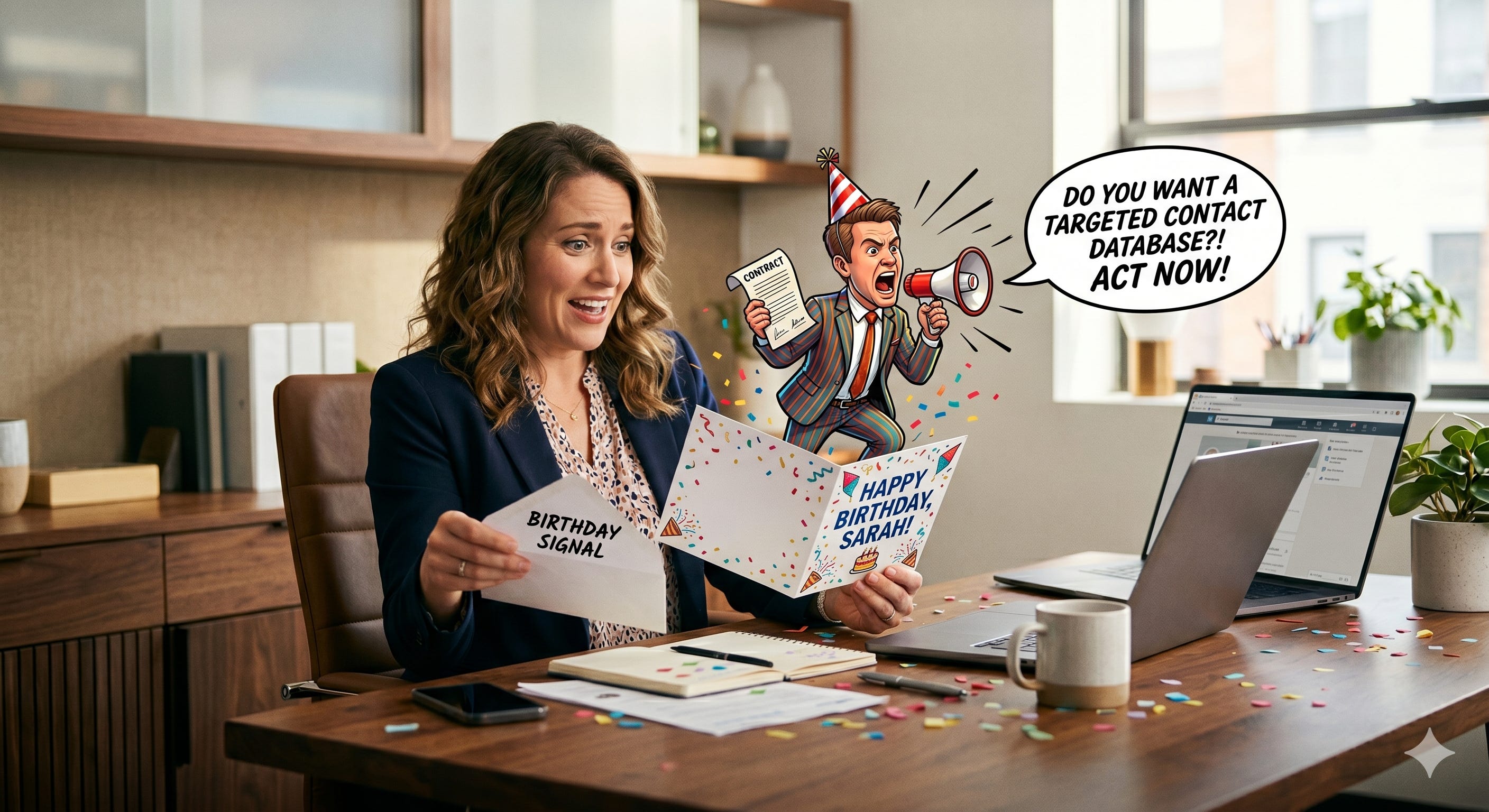
Happy birthday. Do you want a targeted contact database?
Those kinda sucked. That one was mild compared to some I got, too.
Nothing communicates “I hope your day is special” to you quite like immediately placing my birthday into your lead-gen funnel as a recurring event or follow-up tickler, amirite? (Yes, that was sarcasm.)
Don’t be a salesy weirdo. Earn those conversations.
A Notification Is Not A Relationship
LinkedIn makes it easy to know when something happens in someone’s professional or certain aspects of their personal life. It tells us when someone has a birthday, a new role, a work anniversary, and so on.
But the real opportunity is not the notification… it’s what you do with it. Because staying in touch has become a lost art.
It’s not that people don’t know how to stay in touch. They send plenty of messages, believe me. The ones they do send, though, just aren’t good. But the message itself doesn’t build the relationship… your response does. And that is where most people miss the moment.
Staying in touch has also become a lost art because too many people confuse contact with connection. They just want to tick that box in their CRM that says whatever the equivalent of “reached out” is.
That’s not the right way to think about all of this.
Don’t get me wrong… simple messages can be great. But there is a difference between simple and forgettable. Simple can be thoughtful, but forgettable is what happens when the recipient can tell you spent less time on the message than LinkedIn spent generating the reminder.
Video And Voice Can Work, But Only If You Mean It
Sending a video message via LinkedIn’s video messaging can be a great way to stand out from the crowd. Why? Very few people use it, even today. A LinkedIn voice note can help you rise above, too.
But they only work when the message is actually personal. A reused video message is not personal. A voice note when you say the same thing every time, except that you change the name, is not personal. A “personalized” message that could have been sent to 900 people is not personal.
The medium does not create the meaning. The intention does.
A quick video saying:
“Hey, Lisa, just saw it was your birthday and wanted to send a real message instead of the standard LinkedIn one. Hope it’s a great day.”
… can work beautifully. Why? Because hardly anyone does it.
Plus, it shows effort. Not massive effort, or “stalker/weirdo” effort. Not “I hired Quentin Tarantino to make this video for you” effort. Just enough effort to show the person that you noticed them. That matters.
Give Value Without Turning It Into An Ambush
Another way to use birthdays and similar LinkedIn triggers is to give something useful to those you’re messaging. But this is where people need to be careful.
Giving value does not mean disguising a pitch as a birthday present. It does not mean saying, “Happy birthday, here’s my calendar link.” It does not mean, “Congrats on the new role, want to talk about how we help companies like yours?”
Those do not signal value. Those are sales ambushes wearing a party hat.
If you are going to send something, make sure it is genuinely useful even if the person never replies, never books a call, and never becomes a client. Yep… that’s the standard you’re looking for.
For example, if you help people with LinkedIn profiles, you might say:
“Happy birthday, Karen. Every year, I like to use my birthday as a reminder to do a quick LinkedIn profile checkup, so I thought I’d pass along this simple checklist. No need to reply. Just thought it might be useful.”
That works because the gift is useful on its own. It does’t require a meeting, a full discovery call, or the ol’ “let’s jump on a quick call” to unlock the actual value. (Yours is probably wildly different from mine, but I think you get the picture here.)
Trust starts when an item’s monetary value is zero, but the help it provides can’t be measured in dollars, euros, gold, crypto, or whatever.
Job-Related Reminders Aren’t Open Invitations to Pitch
When someone starts a new role, LinkedIn gives you a natural reason to reconnect. But again, the mistake is rushing the sales angle.
Unlike birthdays, a job change can signal a business opportunity for most salespeople. Yes, someone in a new role may eventually need what you do. And yes, the first 90 days in a new position can be a meaningful window where the right insight, resource, or connection could help them in that new gig.
In certain cases, a job anniversary can do so, too, especially for career strategists and recruiters.
No matter what the case, though, your first message in either one of those situations should be a pitch. Start like a human… you know how! But if you’re stuck on exactly what to write, here’s a short example:
“Congrats on the new role, James. Hope the first few weeks are off to a strong start.”
That alone is fine.
Better yet, if you have something genuinely helpful for someone stepping into that role, offer it without pressure:
“Congrats on the new role, James. I know the first 90 days can be a lot. I came across this piece on what sales leaders often wish they had asked earlier in a new role, and thought it might be useful. No need to reply. Just wanted to pass it along.”
That’s a very different energy right there. It is not “I saw your job change and smelled opportunity;” it’s “I saw you landed a new job and thought this might help.”
That difference matters.
Work Anniversaries Can Reopen Dormant Relationships
When it comes to work anniversaries, it’s more about a light-touch opportunity to reappear in someone’s world. But again, the goal is not to check a box. Instead of “Congrats on the work anniversary!” …
Try something a little more specific:
“Congrats on another year at ABC Company, Denise. I hope it’s been a good one and that the work is still giving you something worth showing up for.”
Or:
“Congrats on the anniversary, Mike. Three years in one place says something these days. Hope the role is still treating you well.”
Simple. Human. Not salesy. And maybe that turns into a conversation… or maybe it doesn’t. Guess what? That’s okay. Not every touchpoint needs to turn into a sales conversation. You’re just keeping the relationship alive.
Rediscover the Lost Art
LinkedIn gives us more opportunities to stay in touch than we probably realize. The problem is not a lack of signals…. the problem is what we do with them. A birthday message can be forgettable, or it can make someone feel seen. A job change message can feel opportunistic, or it can feel supportive. A work anniversary message can be a throwaway, or it can be a small relationship touchpoint that reopens a conversation.
The difference isn’t complicated. Just slow down, make it personal, nuke that pitch, and offer genuine value when it makes sense.
And remember that staying in touch is not about chasing the next sales conversation. It is about earning the right to have one.
So, remember:
Don’t be a salesy weirdo. Earn the conversation.
NOTE: The hero image for this article was generated with AI, because there’s no way I had the skills or patience to produce it myself.

Having trouble earning those sales conversations? Our FREE eBook, Why You’re Not Getting Conversations (Even With a Great Network), can help.
Most people get LinkedIn wrong because they’ve been taught to use it like email: send messages, drop links, and ask for time. But that’s not what buyers want. Fix what’s broken in your LinkedIn strategy with this eBook. Download it… today!